Jonathan Gratch
Professor of Computing · College of Connected Computing · Director, Affective Computing Group, Vanderbilt University
About

Jonathan Gratch is a Professor at Vanderbilt University's College of Connected Computing, where he directs the Affective Computing Group. His research develops human-like software agents for virtual training, therapy, negotiation and education environments, and uses these computational methods to give concrete, testable form to psychological theories of human behavior. He is the founding Editor-in-Chief of IEEE’s Transactions on Affective Computing (retired), Associate Editor of Affective Science, Emotion Review and former President of the Association for the Advancement of Affective Computing (AAAC). He is a Fellow of the Association for the Advancement of Artificial Intelligence (AAAI), the Cognitive Science Society and AAAC. Before joining Vanderbilt, he was Chief Scientist at the USC Institute for Creative Technologies and Director of the USC Affective Computing Group. He is actively recruiting PhD students at Vanderbilt.
Research Interests
Affective computing, cognitive modeling, human-computer interaction, virtual humans, and persuasive technology. Across these areas, the throughline is the same: building working computational models of psychological theory, so that ideas about how people think, feel, and interact can be instantiated, systematically manipulated, and empirically tested — not just described.
Emotion as the Foundation of Social Intelligence
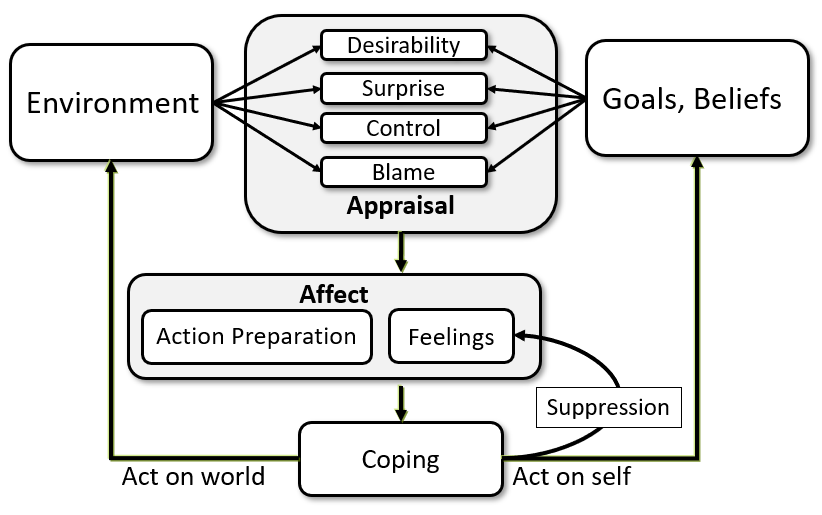
Emotion is not an add-on to intelligence — it is a mechanism that prepares agents for action in complex, uncertain worlds and coordinates social interaction with human users. Building on appraisal theory, my research models how emotion organizes decision making, coping, and action selection. Building on reverse appraisal theory, it studies how emotional expressions influence the beliefs, trust, and decisions of interaction partners. Recent work suggests that appraisal-based representations also emerge in large language models, reinforcing the relevance of these theories for modern AI.
- A Domain-independent Framework for Modeling Emotion (2004)
- Social Functions of Machine Emotional Expressions (2023)
- Mechanistic interpretability of emotion inference in large language models (2025)
Emotion in Negotiation
Negotiation is an important testbed for social AI because it is a real-world setting where emotion, strategy, and stakes all matter. This line of research studies how emotional feelings and expressions influence verifiable outcomes such as cooperation, fairness, trust, and agreement quality. It also helps define negotiation as a challenge domain for socially intelligent AI, including work on automated negotiators and emotionally-aware dispute resolution.
- Negotiation as a Challenge Problem for Virtual Humans (2015)
- Emotionally-Aware Agents for Dispute Resolution (2025)
- Artificial Intelligence and Negotiation: A Framework for an Emerging Field (2026)

AI for Mental Health and Human Development
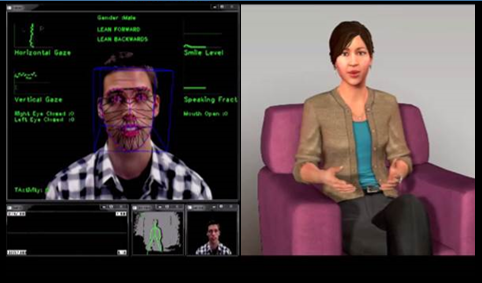
My research uses socially intelligent agents to support mental health assessment, rapport building, and skill training. Work in this area shows that people may disclose more sensitive information to virtual humans than in traditional interviews, and that embodied agents can help identify markers associated with depression and PTSD. More recent projects extend these ideas to conflict-resolution training for caregivers, showing how conversational AI can support both assessment and intervention in high-stakes settings.
- It's Only a Computer: Virtual Humans Increase Willingness to Disclose (2014)
- SimSensei: A Virtual Human Interviewer for Decision Support (2014)
- Transforming a Negotiation Framework to Resolve Conflicts between Older Adults and Caregivers (2023)
Computers as Social Actors
People naturally treat computers and AI systems as social actors, but the consequences depend heavily on system design and context. This research examines when human-like behavior improves rapport, trust, and collaboration, and when it produces unintended effects such as misplaced trust, altered social roles, or unethical behavior. More recent work with collaborators extends this theme to the psychology of AI in social relationships, power, and status.
- Creating Rapport with Virtual Agents (2007)
- Human Cooperation when Acting Through Autonomous Machines (2019)
- The Power to Harm: AI Assistants Pave the Way to Unethical Behavior (2022)
Teaching
I am not yet teaching at Vanderbilt but I regularly teach a course on Affective Computing
Syllabus (PDF)Contact
Vanderbilt University
College of Connected Computing
Nashville, TN